|
||

podział tematyczny • wydawnictwa anglojęzyczne podział tematyczny Newsletter: • Zamów informacje o nowościach z wybranego tematu Informacje: • sposoby płatności i dostawy • kontakt • Cookies na stronie • Regulamin zakupów Napisz propresssp@gmail.com |
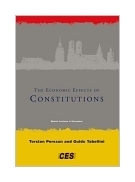
ECONOMIC EFFECTS OF CONSTITUTIONPERSSON Twydawnictwo: MIT , rok wydania 2005, wydanie Icena netto: The authors of The Economic Effects of Constitutions use econometric tools to study what they call the "missing link" between constitutional systems and economic policy; the book is an uncompromisingly empirical sequel to their previous theoretical analysis of economic policy. Taking recent theoretical work as a point of departure, they ask which theoretical findings are supported and which are contradicted by the facts. The results are based on comparisons of political institutions across countries or time, in a large sample of contemporary democracies. They find that presidential/parliamentary and majoritarian/proportional dichotomies influence several economic variables: presidential regimes induce smaller public sectors, and proportional elections lead to greater and less targeted government spending and larger budget deficits. Moreover, the details of the electoral system (such as district magnitude and ballot structure) influence corruption and structural policies toward economic growth. Persson and Tabellini's goal is to draw conclusions about the causal effects of constitutions on policy outcomes. But since constitutions are not randomly assigned to countries, how the constitutional system was selected in the first place must be taken into account. This raises challenging methodological problems, which are addressed in the book. The study is therefore important not only in its findings but also in establishing a methodology for empirical analysis in the field of comparative politics. 320 pp. Księgarnia nie działa. Nie odpowiadamy na pytania i nie realizujemy zamówien. Do odwolania !. |